*Paul Lockhart*
# Progressive Summary
# Definitions
# Chapter Notes
## Introduction
Arithmetic is the combination and comparison of known values. Algebra is the deductive task of finding the values of unknown quantities.
Algebra is a bit like tying and untying knots. Instead of string, we work with numbers, and instead of drawing through and looping, we are using operations like multiplying and subtracting.
> Ultimately, algebra (i.e., the art of solving mystery number puzzles) arises, like most aspects of civilization, from our desire for control.
> At any rate, it is clear that more than four thousand years ago mathematics had already begun to break away from the mundane practical world. A small group — members of the elite priestly and scribal classes, essentially — had the leisure time to investigate numbers and their properties for their own amusement and intellectual satisfaction. The fact that this inquiry also leads to powerful general methods as well as deeper insight and understanding means that the original realworld problems and applications then appear as trivial special cases by comparison.
>
> Thus, algebra becomes the fine art of tangling and untangling abstract numerical information. The setting shifts from the construction site and the counting house to the idealized realm of pure number. Our problems cease to be practical and utilitarian and are instead driven by curiosity and aesthetics. We leave the noisy and complicated world of physical reality behind and move to a quieter, more peaceful realm of abstract pattern and ideal beauty — a place I like to call Mathematical Reality. This is the setting in which algebraists have been conducting their business for the past forty centuries.
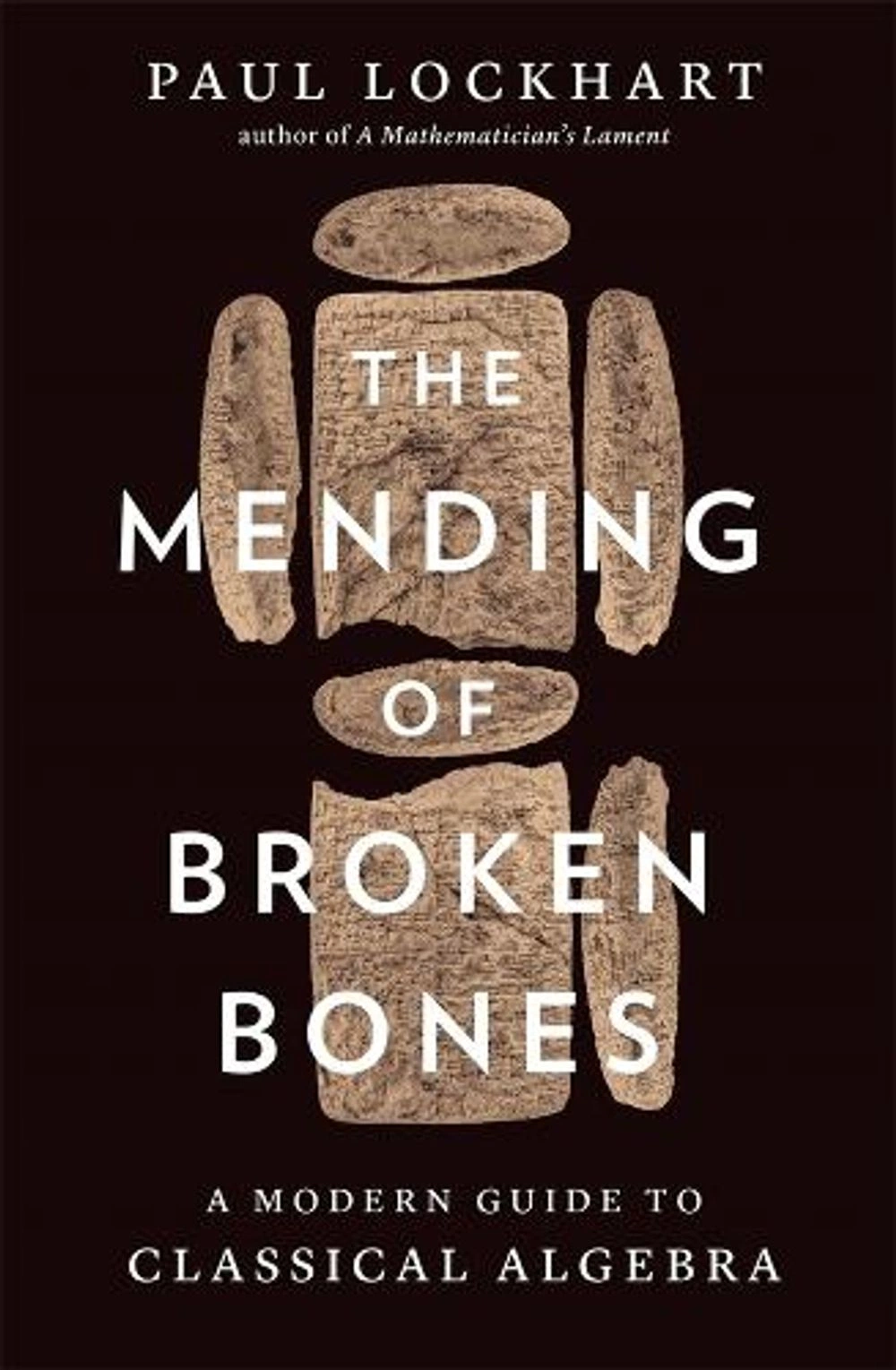
> Our word algebra comes from the Arabic al-jabr, meaning “the way of completion” or, more poetically, “the mending of broken bones.” Our numbers have been shattered into pieces, strewn about in various ways, and now we want to reassemble them.
> The human urge, when confronted with variety, is to sort and categorize. This is in fact the single most fundamental mathematical act: deciding when two things are to be considered the same or not. Even the simple act of counting relies on a tacit agreement as to which items are to be considered distinct, individual units.
> When we find ourselves deep in the jungle, our vision is often impaired — obscured by the very trees and vines we are interested in studying. These are the details and the particulars. To understand the lay of the land, we need to gain altitude — to climb a hill of some sort. This hill is generality. The more abstract and general our patterns and ideas, the more they encompass and the more they allow us to see. What we gain is perspective, and that is a rare and precious commodity. This can sometimes be a fairly difficult climb, but the view is always worth it.
> Specific problems in physics and geometry yield to vast generalizations, revealing unforeseen connections among disparate subject areas and leading to elegant and far-reaching unifications. Abstraction heaped upon more abstraction! Mathematicians are addicted to altitude. The greatest height reveals the greatest depth, and the feeling is intoxicating.
> Classical algebra, which I will define loosely as the period from roughly 2500 bc to about 1800 ad, is primarily concerned with the study of number puzzles arising from arithmetic — that is, the knots we tie are created using the operations of addition and subtraction, multiplication and division, applied to numbers both known and unknown.
> Modern algebra is the study of systems of activities and operations in general — numerical, geometrical, physical, whatever. At this level of generality, what matters is not so much the string as it is the ways knots are formed — the various moves and maneuvers and how they combine.
## Numbers
Adding fractions and negative numbers was a big step in increasing the practical utility of our number system. But the shift from thinking of numbers as quantities to thinking of them as entities was more important mathematically.
> The modern mathematical notion of number is far more abstract and general. Numbers are creatures that engage in behavior, and it is the behavior that matters more than the creatures. It turns out that we can capture the behavioral properties of numbers — for all our algebraic intents and purposes — without having to commit to what they actually are.
>
> What this means is that a modern algebraist does not study numbers in the usual sense but rather algebraic structures — systems of entities and operations, together with specific demands on their behavior. This greatly expands the algebra project to include the study of pretty much any way of combining anything, especially activities such as permutations, geometric transformations, and sliding block puzzle maneuvers. In this way, algebra grows to encompass more and more phenomena. New, more abstract notions of negation or multiplication allow for wider scope; the higher we climb the more we see.
> Mathematics is sometimes called “the science of necessary consequences.” The idea is that we make our various assumptions (for instance, the behavioral demands we place on numbers) and then we deduce the consequences. Whenever an unnecessary assumption can be removed or a new, exciting consequence added, this is progress. The goal of the mathematician is to understand — as simply and as elegantly as possible — which assumptions lead to which conclusions. In order to have the clearest possible view of this complex logical hierarchy, we want our imaginary structures to be as tight and minimalist as they can be, with no excess fat.
# Quotes
# References