## Metadata
- Author: [[Patricia Ononiwu Kaishian]]
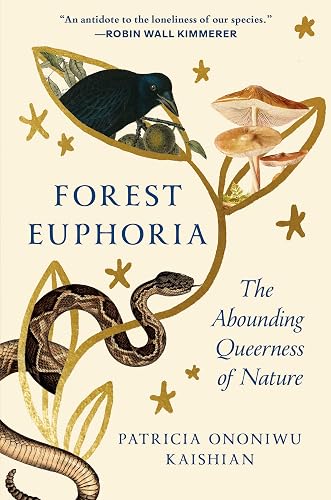
- Full Title: Forest Euphoria
- Category: #books
## Highlights
- I learned to bear witness to the profusion of biological forms that surrounded me. I began to see that diversity is not only abundant in nature but is its very premise. The beings of our world are bound together by webby agreements predicated on difference. We all engage in special earthly pacts, trading energy through water, sunlight, iron, and sugar, each of us taking and contributing, each of us necessarily different. ([Location 132](https://readwise.io/to_kindle?action=open&asin=B0D9QDKQST&location=132))
- Queer theory asks: What has been categorized as normal, and why? How does the structure of our society—in the forms of race, gender, religion, orientation, ability, and even species—reinforce this categorization? ([Location 213](https://readwise.io/to_kindle?action=open&asin=B0D9QDKQST&location=213))
- All of us have special gifts that are beautifully suited for building community, demonstrating resilience, solving problems, or fostering joy. All these skill sets are necessary, invited, and worthy. Climate change is not a technological problem to be dealt with by scientists or environmentalists alone—it is a multidimensional planetary epoch that requires collective reimagining. ([Location 260](https://readwise.io/to_kindle?action=open&asin=B0D9QDKQST&location=260))
- Forests, swamps, grasslands, and deserts—and even, to an extent, our urban environments—are the anti-plantations. If the plantation demonstrates domination, competition, and greed, then biodiverse landscapes and queer, Zoroastrian, and kincentric ecologies show us cooperation, generosity, and abundance. ([Location 274](https://readwise.io/to_kindle?action=open&asin=B0D9QDKQST&location=274))
- Ultimately, queerness invites us all, regardless of our identities, to be more undefined, unclear, transitional, merging, interdependent, cooperative, and nonhierarchical—a very fungal way of being. ([Location 279](https://readwise.io/to_kindle?action=open&asin=B0D9QDKQST&location=279))
- What if, instead of the “birds and the bees,” we told kids about slugs? What if we, like my friend Red, used these creatures to teach kids about ethical, caring sexual encounters? This is what I call “queer-informed education”—an education that aims to speak plainly about biology, eliminate shame around the body and bodily functions, teach careful decision-making for relationships and personal health, center consent and autonomy, and foster a practice of mutual care and respect for other types of bodies, orientations, and ways of being. I believe queerness, in its most expansive sense, has something to teach all of us, no matter how we identify. ([Location 436](https://readwise.io/to_kindle?action=open&asin=B0D9QDKQST&location=436))
- I found in fungi what we call a “special interest” in neurodivergent speak, one interest to rule them all. They became my most constant companion, my queer lover, a bioluminescence in the night of life. ([Location 799](https://readwise.io/to_kindle?action=open&asin=B0D9QDKQST&location=799))
- Beetles are richer in species than any other single group of extant animals. About one out of every four animal species is a beetle. ([Location 827](https://readwise.io/to_kindle?action=open&asin=B0D9QDKQST&location=827))