## Metadata
- Author: [[Emily Herring]]
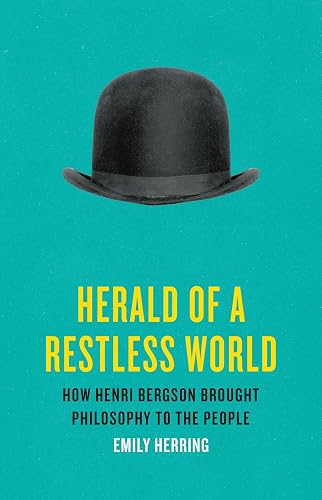
- Full Title: Herald of a Restless World
- Category: #books
## Highlights
- “What I dislike about Paris,” he told his friend Jacques Chevalier, “is the lack of sunshine, the lack of air, the lack of silence.… People talk about progress. But every new advance is accompanied by the invention of a new kind of noise: trains, cars, aeroplanes.… I would have loved to live in the countryside.” ([Location 248](https://readwise.io/to_kindle?action=open&asin=B0CTZR4S72&location=248))
- his description of the flow of time as gradually ripening a person’s existence from within. ([Location 274](https://readwise.io/to_kindle?action=open&asin=B0CTZR4S72&location=274))
- Words, Bergson said, are mere labels we affix to things. We use concepts to tidy up the overwhelming diversity of reality into neat boxes. But in doing so, we often lose sight of what is special and particular about the different aspects of reality that our words describe, including our own inner lives. Beneath this monochromatic conceptual veil, our vibrant, unique self remains hidden out of reach, unless we know how to look for it. ([Location 291](https://readwise.io/to_kindle?action=open&asin=B0CTZR4S72&location=291))
- For a time he had been the most talked-about person on the planet, but as I would learn, his name meant very little to most of the academics I encountered in the anglophone world. It has always seemed unbelievable to me that such an extraordinary figure and his incredible story could have been almost entirely forgotten. ([Location 306](https://readwise.io/to_kindle?action=open&asin=B0CTZR4S72&location=306))
- In the early years of the twentieth century, his defining of life and consciousness in terms of freedom and creativity reassured those who worried that new discoveries in biology had reduced human existence to a cold mechanical process. His critique of the static symbolism of science resonated deeply with those who had grown suspicious of what they viewed as the excesses of rationality and technology. ([Location 321](https://readwise.io/to_kindle?action=open&asin=B0CTZR4S72&location=321))
- The final words of Bergson’s 1932 book The Two Sources of Morality and Religion could have been written today: “Mankind lies groaning, half-crushed beneath the weight of its own progress. Men do not sufficiently realise that their future is in their own hands. Theirs is the task of determining whether they want to go on living or not.” ([Location 325](https://readwise.io/to_kindle?action=open&asin=B0CTZR4S72&location=325))
- As Bergson was putting the final touches on his PhD thesis, artists, intellectuals, and even scientists were voicing increasingly loud concerns about what they viewed as the excesses of technology and science. The French novelist and literary critic Paul Bourget spoke of a “bankruptcy of hope” caused by science’s empty promise “to unriddle the problems of which revelation offered a solution” that was nothing less than “a war against the spirit.”2 Excessive faith in science and technology was seen as ridding the world of wonder, beauty, and mystery, leaving little room, it seemed, for religious beliefs or the notion of free will. For example, many early twentieth-century thinkers, including some biologists, saw Darwinism as a pessimistic depiction of nature that needed to be combatted. As the American poet and essayist Charles Leonard Moore wrote: For fifty years or more, the Gorgon head of Evolution has turned the heart and soul of man to stone. Caught in a mechanical determinism, mankind has lost its freedom—the fluidity which before yielded to all impulses of religion, poetry, and art. If it tried to escape in philosophy, it found that philosophy was fixed in an iron system of concepts which opened only on nescience and nihilism. ([Location 1146](https://readwise.io/to_kindle?action=open&asin=B0CTZR4S72&location=1146))
- This occult revival translated a desire to find meaning beyond, in the words of the poet Anatole France, “the depressing majesty of physical laws.”5 Therefore, said France, “we seek after mystery.… We throw ourselves wholeheartedly into psychical research, the last refuge of the marvellous, which astronomy, chemistry, and physiology have driven from their domain.” ([Location 1167](https://readwise.io/to_kindle?action=open&asin=B0CTZR4S72&location=1167))
- In the title of his 1889 article, France asked: “Why are we sad?” The culprit, he said, was science: “We have eaten the fruit of the tree of science and the taste of ashes remains in our mouths.” He concluded with a plea for help: “Who will bring us new faith and new hope?”7 The same year, Bergson shared the manuscript of his PhD thesis, “Essai sur les données immédiates de la conscience” (Time and Free Will), and his idea of durée, with the world. ([Location 1172](https://readwise.io/to_kindle?action=open&asin=B0CTZR4S72&location=1172))
- According to Bergson, psychophysics belonged to a long tradition of theories that inserted space into the nonspatial and quantity into the unquantifiable. Fechner’s thinking perfectly embodied the confusion that Bergson had started seeing everywhere between temporal and spatialised realities. ([Location 1196](https://readwise.io/to_kindle?action=open&asin=B0CTZR4S72&location=1196))
- In our everyday life, when we talk about the intensity of our feelings, sensations, and emotions, we use the language of physical measurement and quantity. We speak of immense joy, or we say that the pain in our arm is greater than the pain in our leg. Whether we realise it or not, we treat our internal experiences as quantifiable, as though they can be measured against one another. This is spatial thinking. In space, objects can be placed next to one another. The larger object can contain the smaller one. But mental states do not occupy physical space; they cannot be contained. As Guerlac writes, inner states do not have the same boundaries as external things, but rather “overflow into one another, interpenetrate, even as they succeed one another.” ([Location 1200](https://readwise.io/to_kindle?action=open&asin=B0CTZR4S72&location=1200))
- One of his students, the poet Léon-Paul Fargue, remembered that “we felt he was reinventing everything, and that he would go even further. He gently fascinated us with that charm, that look, that forehead.… He ‘captured’ us with a kind of mystical jiu-jitsu.” ([Location 1255](https://readwise.io/to_kindle?action=open&asin=B0CTZR4S72&location=1255))
- In a lecture on Bergson, William James declared: “If anything can make hard things easy to follow, it is a style like Bergson’s.… The lucidity of Bergson’s way of putting things is what all readers are first struck by. It seduces you and bribes you in advance to become his disciple. It is a miracle, and he is a real magician.” ([Location 1259](https://readwise.io/to_kindle?action=open&asin=B0CTZR4S72&location=1259))
- The paradox that Bergson had discovered in his study of the history of the mind was this: human intelligence has evolved in a way that makes it bad at understanding evolution. ([Location 2323](https://readwise.io/to_kindle?action=open&asin=B0CTZR4S72&location=2323))
- In his second lecture, Bergson described in detail his key notion of durée. There are, said Bergson, “changes, but there is no thing that changes: change doesn’t need anything to stand upon. There are movements, but there aren’t necessarily invariable objects that move; mobility does not presuppose something that moves.” ([Location 2806](https://readwise.io/to_kindle?action=open&asin=B0CTZR4S72&location=2806))